
From ancient notation to streaming platforms, music history is shaped by breakthroughs in composition, performance, recording and distribution. Explore the milestones that changed how music is made and heard, arranged in chronological order.
c. 1400 BCE – The Hurrian Hymn
Found on clay tablets at Ugarit in present-day Syria, Hurrian Hymn No. 6 is among the oldest surviving examples of a song with musical notation. Its instructions for a stringed instrument show that people were recording musical ideas thousands of years before modern sheet music. Scholars still debate exactly how it sounded.
c. 1600 – The Emergence of Opera
In Florence, composers began combining dramatic storytelling, singing and instrumental accompaniment into a new theatrical form. Jacopo Peri's Dafne (late 1590s) is often cited as an early opera, while his Euridice (1600) is the earliest surviving complete example. Opera helped establish music as a powerful form of staged drama.
1600–1750 – The Baroque Era

Composers such as Bach, Handel and Vivaldi developed elaborate musical textures and helped popularise concertos, suites and other forms. The Baroque period preceded the Classical era (roughly 1750–1820), rather than being the Classical era itself.
7 May 1824 – Beethoven's Ninth Symphony Premieres
Beethoven's Ninth premiered in Vienna with an unprecedented choral finale for one of his symphonies, setting Friedrich Schiller's words in the famous Ode to Joy. The work demonstrated how voices and orchestra could combine on a monumental scale, influencing generations of composers.
1870s – Microphones Transform Sound

Early microphone designs emerged from several inventors, including Emile Berliner, Thomas Edison and David Edward Hughes. Improvements in electrical sound transmission eventually made broadcasting, amplification and modern recording possible. The microphone was a developing technology, not a single invention attributable to one person in 1877.
Early 1900s – Jazz Takes Shape

Jazz developed in New Orleans from African American musical traditions, blues, ragtime and other influences. Improvisation and rhythmic experimentation became defining features. Artists such as Louis Armstrong and Duke Ellington helped carry jazz to international audiences.
1920s – Electronic Instruments Arrive
Léon Theremin developed the theremin, an electronic instrument played without physical contact. Its unusual sound opened new possibilities for film scores and experimental music, helping establish electronic instruments as a creative medium.
1931 – The Rhythmicon Experiments with Electronic Rhythm
Developed by Léon Theremin with composer Henry Cowell, the Rhythmicon could generate complex rhythmic patterns electronically. It was an early experiment rather than a mass-market drum machine, but it anticipated later rhythm technologies.
1948 – The Long-Playing Record
Columbia Records introduced the 33⅓ rpm microgroove LP, allowing more music to fit on each side of a record. The format made longer albums practical and helped shape the album-focused listening experience.
July 1954 – Elvis Presley's Breakthrough Recording
Elvis Presley recorded That's All Right at Sun Studio in Memphis in July 1954; the single was released on 19 July. Its blend of blues and country became an important moment in the rise of rock 'n' roll, although the genre had deeper roots and many earlier pioneers.
24 May 1956 – Eurovision Begins

The first Eurovision Song Contest took place in Lugano, Switzerland. It grew into an international showcase for popular music, bringing performers and songs to audiences across borders. ABBA's 1974 victory later became one of its best-known success stories.
1959–1980 – Drum Machines Go Mainstream
The Wurlitzer Sideman, released in 1959, brought preset electronic rhythms to performers. Later programmable machines transformed production: the Roland TR-808 and Linn LM-1, both introduced in 1980, helped define the sounds of hip-hop, electronic music and pop.
11 August 1973 – A Landmark in Hip-Hop History
DJ Kool Herc's Bronx party on 11 August 1973 is widely celebrated as a landmark in hip-hop history. His use of extended instrumental breaks helped shape a culture that grew through DJing, MCing, dance and visual art. Hip-hop developed through a wider community, not a single event alone.
1 August 1981 – MTV Launches

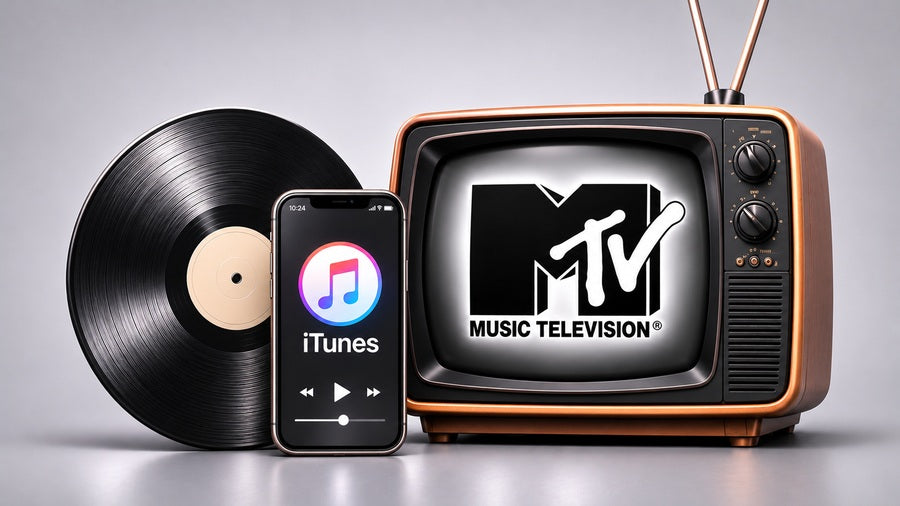
MTV began broadcasting with The Buggles' Video Killed the Radio Star. It was the channel's first music video, not the first music video ever made. MTV helped make visual identity, choreography and promotional filmmaking central to popular music. Explore the History of Music Videos →
1982 – Compact Discs Reach Consumers

Commercial CDs and players launched in 1982, offering a new digital format for music. Over the following years, CDs displaced cassettes and vinyl in many markets, changing how albums were manufactured, sold and collected.
1989–1991 – Computer Recording Becomes Practical

Digidesign's Sound Tools appeared in 1989, followed by Pro Tools in 1991. These systems helped move recording and editing from tape-based workflows towards computer-based production. Digital audio workstations later made professional techniques accessible to smaller studios and home producers.
2003 – The iTunes Music Store Opens

Apple launched the iTunes Music Store on 28 April 2003. Buying individual digital tracks became a mainstream alternative to purchasing physical albums, accelerating the industry's move towards downloadable music.
2008 – Spotify Expands Music Streaming

Spotify launched in 2008, helping popularise on-demand access to large music catalogues. Streaming changed how listeners discover songs, build playlists and pay for music, while introducing new opportunities and challenges for artists.
2016 – Carved Culture Was Founded

Founded in 2016, Carved Culture set out to make music more accessible by bringing affordable, handcrafted musical instruments from around the world to musicians. Since then, we have expanded into music education, publishing over 700 articles, more than 1,200 videos, instructional music books, courses and interactive music games. Our mission is simple: help more people discover, learn and enjoy music.