
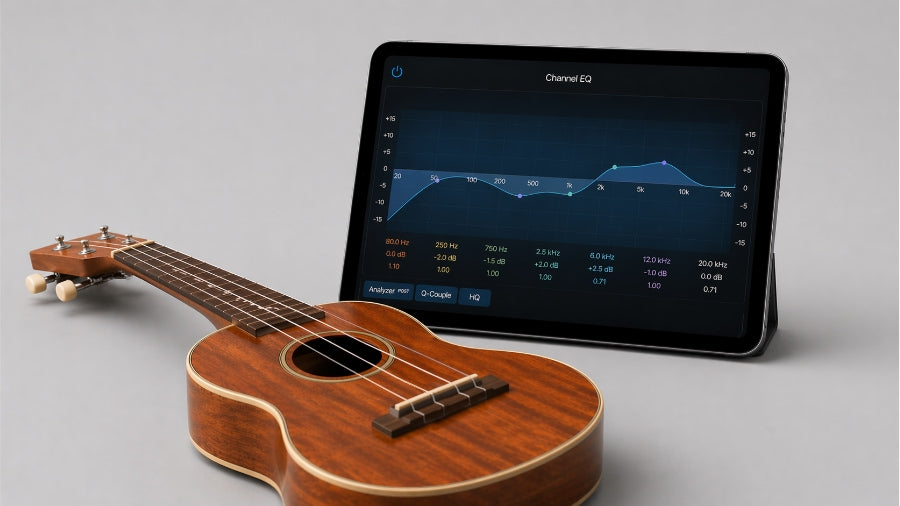
Getting a clean ukulele recording isn’t about heavy processing — it’s about shaping the natural tone so it sits clearly in the mix. Ukuleles are bright, mid-focused instruments with limited low-end, so EQ should tighten the bottom, clean up muddiness, and control excessive sparkle. The goal is clarity, warmth, and definition without harshness.
EQ the Low Frequencies (80Hz–250Hz)
Ukuleles don’t produce deep bass, but they can create low-frequency rumble from handling noise or room reflections. Start with a high-pass filter around 80Hz–100Hz to remove unnecessary low-end without thinning the sound. If the recording feels muddy, try a subtle cut around 150Hz–250Hz. Be conservative — cutting too much here can make the ukulele sound weak or hollow.
Clean the Midrange (250Hz–2kHz)
The mids define the body and character of the ukulele. If the recording sounds boxy, sweep between 300Hz–600Hz and apply a gentle cut. Around 1kHz–2kHz is where articulation and chord clarity live. A small boost in this range can help fingerpicking stand out in a mix. For strumming patterns, avoid over-boosting this area, as it can quickly become sharp or nasal. Balance is key — you want presence without harshness.
Control the High Frequencies (2kHz–10kHz)
Ukuleles naturally carry brightness, especially with new strings. If your recording sounds harsh or brittle, reduce slightly around 3kHz–5kHz. To add sparkle and air, apply a light high-shelf boost around 8kHz–10kHz. This works particularly well for fingerstyle playing. Keep adjustments subtle — ukuleles can become thin if the highs are pushed too aggressively.
Technique Matters More Than EQ

EQ can improve clarity, but most tone issues begin at the source—poor posture, uneven strumming, inconsistent fretting pressure, and weak rhythm all reduce recording quality, while clean technique minimises the need for heavy processing. If you want to get the most from your ukulele for recording, performance, or personal enjoyment, mastering technique is more important than adjusting plugins.
The Complete Ukulele Player is a step-by-step guide covering posture, tuning, chord shapes, rhythm, dynamics, scales, and expression, with clear diagrams, practical exercises, 20 full songs with tablature, and structured tutorials that build a strong foundation for beginners and refine sound for experienced players. Better playing leads to better recordings.


