
Percussion instruments range from low, resonant gongs to crisp wooden blocks and textured shakers. EQ should remove unwanted noise while preserving the attack, overtones and natural character of each instrument. The frequency ranges below are starting points, not fixed presets.
How to EQ a Xylophone
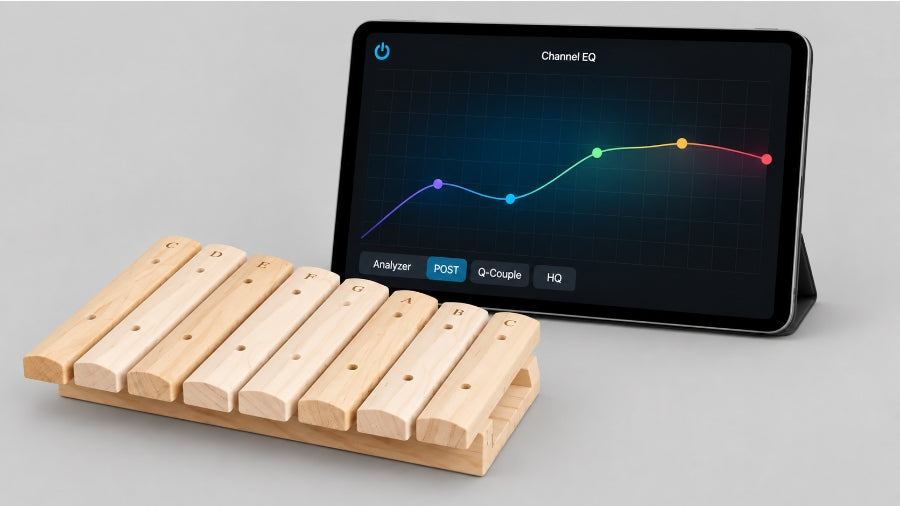
Xylophones need clear pitched notes and natural wooden-bar resonance. The lowest notes of a concert xylophone can extend below the previously suggested 120–180 Hz high-pass range, so do not apply that cutoff automatically. Listen to the lowest note being played and place any high-pass filter safely below its fundamental, only if rumble needs removing. If the recording is hollow or congested, sweep the low mids and make a small corrective cut at the actual problem frequency. A restrained lift around 1.5–3 kHz may improve mallet articulation, while excessive upper-mid boosts can make the strikes brittle. Adjust microphone placement and mallet choice before using heavy EQ.
How to EQ a Gong
Gongs produce complex, often inharmonic overtones and a long decay. Begin without EQ and listen through the full swell, because a large gong can contain useful energy below 60 Hz. If sub-rumble is audible, introduce a gentle high-pass filter well below the lowest musical energy and raise it only until the noise is controlled. Sweep for excessive boom or a dominant metallic resonance and use small cuts where needed; broad boosts around 1–6 kHz can exaggerate harshness. If upper overtones become piercing, try a restrained narrow or dynamic cut rather than removing the natural shimmer. Preserve the instrument’s full decay.
How to EQ a Singing Bowl
Singing bowls produce sustained fundamentals and complex upper harmonics. First identify the lowest important note and avoid a fixed 60–100 Hz high-pass setting, which could weaken a low-pitched bowl. Use a gentle filter only below the useful sound when room or handling rumble is present. If one resonance dominates, find it by ear and apply a small, narrow cut rather than broadly reducing the low mids. Subtle upper-mid changes may reveal the initial strike or the shimmering overtones, but aggressive boosts can make the bowl sound piercing. Record at a suitable distance and preserve its natural sustain.
How to EQ a Rainstick
A rainstick’s character comes from a cascade of small impacts. Use a high-pass filter around 80–150 Hz to remove handling noise, reduce 250–400 Hz if the recording is hollow or congested, and keep the 800 Hz–2 kHz texture mostly natural. Sharp clicks may benefit from a small cut at 3–4 kHz; a gentle 8–10 kHz lift can add sparkle when needed. Preserve the movement and detail of the falling grains.
How to EQ a Tone Block
Tone blocks produce short wooden strikes with little sustain. Start with a high-pass filter around 120–200 Hz, reduce thickness at 200–300 Hz or boxiness at 400–700 Hz, and gently emphasise 1–2.5 kHz for attack. A restrained 4–6 kHz lift can add clarity; soften 7–9 kHz if the clicks become harsh. Prioritise rhythmic definition over bass.
How to EQ a Guiro
A guiro produces rhythmic scraping textures rather than sustained notes. Remove handling noise with a high-pass filter around 120–200 Hz, reduce boxiness at 250–400 Hz, and cut 600–900 Hz slightly if nasal. A gentle lift at 1.5–3 kHz can help each scrape remain distinct; 4–6 kHz adds brightness when required. Soften 7–10 kHz if the scraping becomes abrasive.
How to EQ Sleigh Bells
Sleigh bells are naturally bright and fast, so the goal is to keep their rhythmic sparkle without exaggerating noise or harshness. If handling noise or room rumble is audible, try a gentle high-pass filter around 150–250 Hz, raising it only until the unwanted low frequencies disappear without thinning the bells. Larger sets can sound congested around 300–600 Hz; make a small cut only if you hear that buildup. A restrained boost around 2–4 kHz may clarify individual jingles, but avoid adding presence automatically. If the recording sounds dull, a subtle adjustment around 5–7 kHz may help; if it is piercing or scratchy, sweep around 8–10 kHz and reduce the offending range gently. Always check the bells in the full mix so they add movement without overpowering other instruments.
Common Percussion EQ Mistakes
Applying the same EQ curve to every instrument can remove important fundamentals or exaggerate harsh overtones. Make subtle adjustments, preserve the instrument’s natural tone and check microphone placement before relying on processing.
Ready to Go Beyond EQ?

EQ is only one part of music production. Become a Producer introduces rhythms, sound selection, musical layers and arrangement to help you turn ideas into finished instrumentals.


