
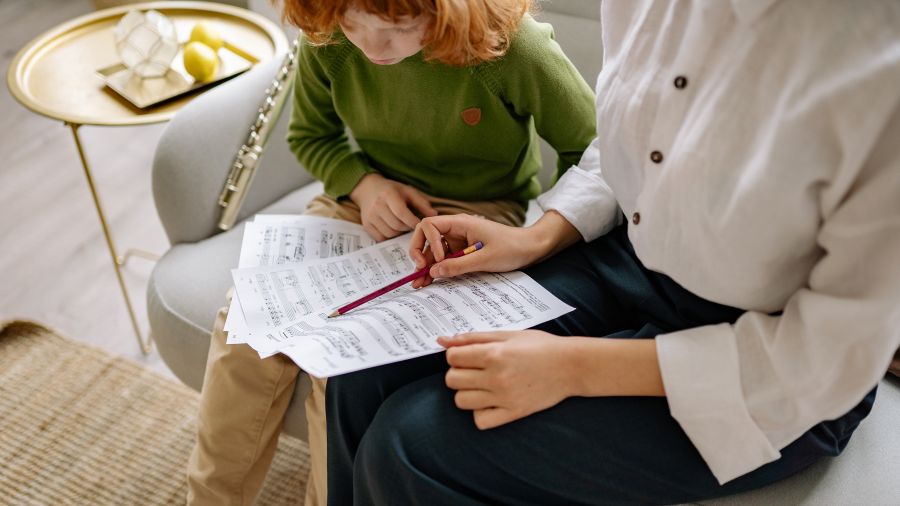
Sheet music shows which notes to play, when to play them and how they should sound. Start with the staff and clefs, then learn note names, rhythm and the symbols that guide a performance.
1. Understand the Staff

The staff consists of five horizontal lines and four spaces. Each line and space represents a different pitch: notes placed higher on the staff generally sound higher, while notes placed lower sound lower. A clef at the beginning of the staff determines which pitches the lines and spaces represent.
2. Learn the Clefs

The treble clef (𝄞), also called the G clef, curls around the second line from the bottom (G) and is commonly used for higher notes, including violin, flute and the right hand on piano. The bass clef (𝄢), also called the F clef, has two dots surrounding the second line from the top (F) and is commonly used for lower notes, including cello, tuba and the left hand on piano. Always check the clef, as the same staff position represents different notes depending on which clef is used.
3. Learn Note Names

Notes are named A to G and repeat as you move up or down the staff. In the treble clef, the lines from bottom to top are E, G, B, D, F (“Every Good Boy Does Fine”), while the spaces spell F, A, C, E (“FACE”). In the bass clef, the lines are G, B, D, F, A (“Good Boys Do Fine Always”) and the spaces are A, C, E, G (“All Cows Eat Grass”). Use the chart above to practise locating each note.
4. Understand Rhythm & Note Values

Rhythm tells you when to play and how long to hold each note. In 4/4 time, a whole note lasts 4 beats, a half note 2 beats, a quarter note 1 beat and an eighth note ½ beat. Shorter values include sixteenth notes (¼ beat), thirty-second notes (⅛ beat) and sixty-fourth notes (¹⁄₁₆ beat). Each note value also has a matching rest, indicating silence for the same duration.
5. Time Signatures
A time signature tells you how beats are grouped into bars. In 4/4, there are four quarter-note beats per bar; in 3/4, there are three, as in many waltzes. In 6/8, each bar contains six eighth notes, commonly felt as two groups of three. The top number indicates how many note units fit in a bar, and the bottom number identifies the note value being counted.
6. Key Signatures
A key signature is the group of sharp (♯) or flat (♭) symbols written after the clef. It tells you which notes are normally raised or lowered throughout the piece. For example, a key signature with one sharp means that F is played as F♯ unless another symbol changes it. You do not need to memorise every key signature at once: begin by recognising what each sharp or flat changes.
7. Accidentals: Sharps, Flats & Naturals
An accidental changes the pitch of a note: a sharp (♯) raises it by a semitone, a flat (♭) lowers it by a semitone and a natural (♮) cancels a sharp or flat. On a piano, C♯ is the black key immediately to the right of C, while C♭ is the white B key immediately to its left. Accidentals generally apply to the same note and octave for the remainder of that bar, unless cancelled; a key signature continues to apply across bars.
8. Dynamics
Dynamics show how loudly or softly to play. Common markings include pp (very soft), p (soft), mp (moderately soft), mf (moderately loud), f (loud) and ff (very loud). A crescendo (<) gradually increases volume, while a diminuendo (>) gradually decreases it.
9. Articulation Symbols
Articulation tells you how to play or connect notes. Staccato (a dot above or below a note) means short and detached; a slur indicates notes played smoothly together; an accent (>) emphasises a note; and tenuto (a short line) asks you to give the note its full value, often with gentle emphasis.
10. Repeats, Codas & Endings
These markings help you follow the structure of a piece without printing the same music repeatedly. Repeat signs (𝄆 𝄇) tell you to replay a section. First and second endings provide different endings on successive passes. D.C. means return to the beginning, while D.S. means return to the sign; Fine marks an ending, and a coda marks a separate closing section when directed.
11. Tempo Markings
Tempo describes how fast music should be played. You may see terms such as Largo (very slow), Adagio (slow), Andante (walking pace), Moderato (moderate), Allegro (fast) or Presto (very fast). A metronome marking such as ♩ = 120 means 120 quarter-note beats per minute.
12. Practise Reading Simple Pieces
Start with simple sheet music — beginner piano books, familiar children's songs like "Twinkle Twinkle Little Star," or melodies you already know by ear, which makes it easier to connect what you see with what you hear. Focus on matching each note on the page to the correct key or position on your instrument, and keep a steady beat as you play.
Bonus Tips
Clap rhythms before playing them, read a few notes at a time and practise slowly with a steady beat. Short, regular sessions are more useful than rushing through a difficult piece. Note-reading apps can provide extra practice, but playing familiar melodies is an effective way to connect the symbols on the page with their sounds.
Put Your Sheet Music Skills into Practice

Reading music becomes easier when you practise real songs. The Piano Sheet Songbook features 96 piano pieces, from nursery rhymes and folk melodies to classical favourites, helping you develop note-reading, timing and accuracy. With clear notation and pieces to revisit as you improve, this 105-page PDF helps turn recognised notes into music. Download instantly and practise at your own pace on a piano or keyboard.