
Indian temples use a wide range of musical instruments during worship, rituals, processions, chanting and dance. This guide explores some of the most important temple instruments, their sounds and the roles they play in devotional traditions.
Tavil (or Thavil)

The tavil is a large, barrel-shaped drum associated with Tamil Nadu and South Indian temple music. It is traditionally played with a stick on one head and the fingers on the other. Its powerful rhythms commonly accompany the nadaswaram during ceremonies and processions.
Nadaswaram

The nadaswaram is a large double-reed wind instrument with a powerful, penetrating sound. It is closely associated with South Indian temples, where it is played during ceremonies and processions, often alongside the tavil. Together, these instruments provide a distinctive musical accompaniment to worship and celebrations.
Mridangam

The mridangam is a two-headed, barrel-shaped drum and the main percussion instrument of South Indian Carnatic music. Its contrasting drumheads allow players to create a wide range of tones through striking, pressing and other hand techniques. It supports vocal and instrumental performances, including devotional concerts and music performed during temple festivals.
Bell (Ghanta)

The ghanta is a ritual bell used during prayers and ceremonies. In Hindu worship, its clear, ringing tone can mark the beginning of a ritual or accompany puja. The sound is regarded as auspicious and helps focus attention on worship. Our Puja Ghanta Bell is a handheld brass bell with an internal clapper.
Shankha (Conch Shell)

The shankha is a conch shell traditionally blown during Hindu temple rituals, ceremonies and puja. Commonly associated with the shell of Turbinella pyrum, it functions as a ceremonial trumpet and produces a deep, resonant sound. In Hindu tradition, the shankha is regarded as sacred and auspicious and is particularly associated with Vishnu.
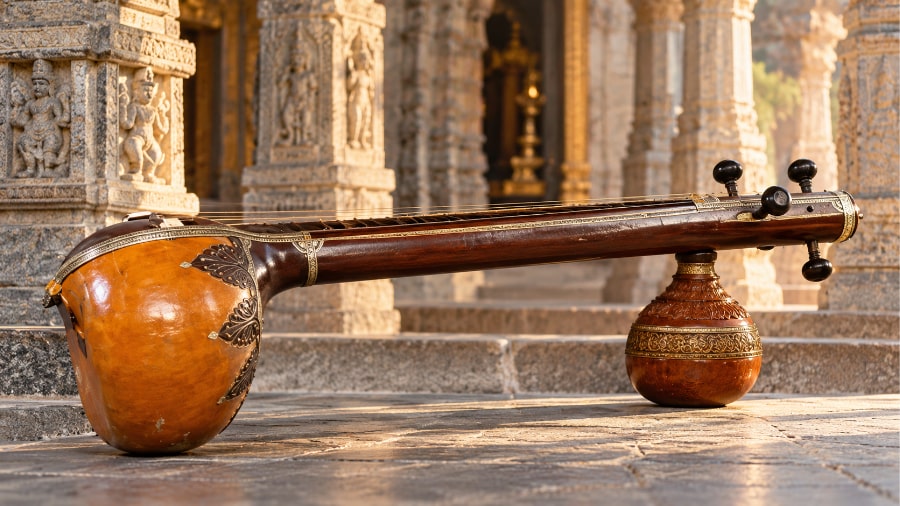
Veena

The veena is a plucked string instrument central to South Indian Carnatic music. The Saraswati veena has a fretted neck and a resonant wooden body, allowing players to create flowing melodies and the expressive ornamentation characteristic of Indian ragas. Associated with the goddess Saraswati, it symbolises music, wisdom and learning and is heard in devotional performances as well as classical concerts.
Dholak

The dholak is a two-headed hand drum widely used in Indian folk music, celebrations and devotional gatherings. Its two drumheads produce contrasting deep and high tones, allowing players to build lively rhythms or gentler accompaniment. It is often heard supporting bhajans and group singing. The dholak should not be confused with the larger dhol, which is usually played with sticks.
Tabla Drums

The tabla is a pair of hand-played drums central to North Indian Hindustani classical music. The smaller dayan produces higher-pitched tones, while the larger bayan produces deeper sounds. Players combine finger and hand techniques to create intricate rhythmic patterns. In devotional settings, tabla can accompany bhajans, singers and other instruments.
Tanpura (Tambura)

The tanpura is a long-necked string instrument that provides a continuous drone rather than a melody. Its repeated, resonant tones give singers and instrumentalists a tonal foundation. It is used in Indian classical music and devotional performances, supporting the voice without adding a separate melodic line.
Sitar

The sitar is one of India's most internationally recognised instruments and is central to North Indian Hindustani classical music. Its plucked strings and sympathetic strings create a distinctive resonant sound. Although not a standard ritual instrument in every temple, it may feature in devotional concerts and cultural performances associated with religious gatherings.
Shehnai

The shehnai is a traditional double-reed wind instrument known for its bright, carrying sound. It has a long association with North Indian temples, religious ceremonies and auspicious occasions. It is also commonly heard at weddings and celebrations, where its sound is associated with good fortune.
Bansuri Flute

The bansuri is a side-blown bamboo flute known for its soft, expressive sound and its use in Indian classical music. It is strongly associated with Krishna and symbolises divine love and devotion. Its melodies can feature in devotional music and performances connected with temple traditions.
Explore Traditional Indian Instruments

Temple music varies by region, community and ceremony. Some instruments signal the beginning of worship, others accompany singing, and others feature in devotional concerts. To explore these sounds in your own playing, browse our traditional musical instrument collection.


