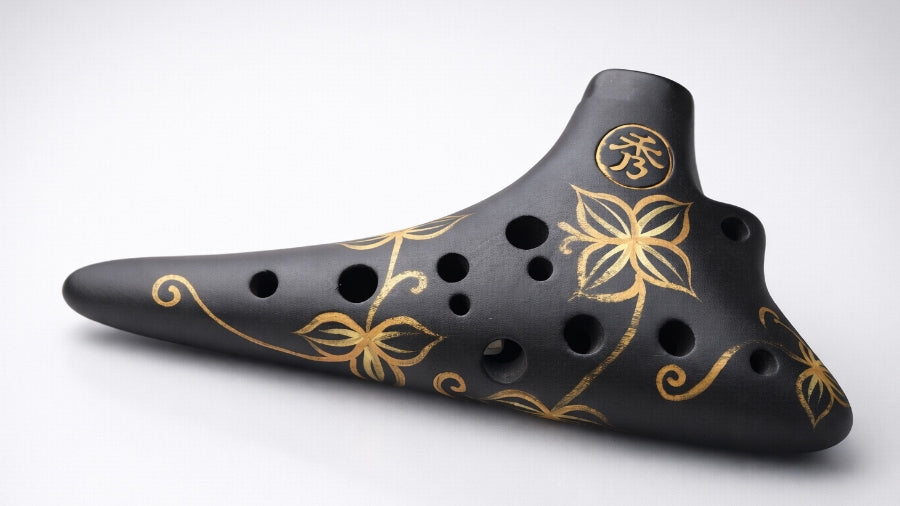
Black ocarina with gold floral design on a clean silver grey studio background

If you’ve ever opened a 12-hole ocarina tab and felt overwhelmed by the extra holes or symbols, you’re not alone. While 12-hole ocarinas look more complex than 6-hole models, the tab system itself is still very logical and beginner-friendly once you understand what you’re seeing. This guide breaks down how 12-hole ocarina tabs work so you can read them confidently and start playing real melodies without needing traditional sheet music or music theory.

What You’re Looking At in a 12-Hole Ocarina Tab

A 12-hole ocarina tab is a visual fingering chart rather than standard notation, showing the ocarina from above with all playable holes: eight front finger holes, two thumb holes, and two subholes used for tuning low notes. Filled (dark) circles mean the hole is covered, while empty (light) circles mean it’s left open, and each diagram represents a single note. You don’t need to memorise note names—simply copy the fingering shown and move through the tabs in order.

Reading Tabs Left to Right (Just Like Text)

You read 12-hole ocarina tabs from left to right, just like text: start on the left, move to the right, and drop to the next line when needed. Each fingering diagram represents one note, so if the same diagram appears twice in a row, you play the same note twice, while wider spacing or longer note stems usually indicate the note should be held for a longer duration.

Understanding Subholes

Subholes are the two small holes near the bottom of the instrument used mainly for low A, low B, and fine pitch control. In tabs, subholes appear as smaller circles, and when filled they should be covered gently, often only partially rather than fully sealed. Avoid pressing hard; subholes rely on precision and light finger placement to achieve clean accurate tuning.

Breath Control Matters More on a 12-Hole Ocarina

Breath control matters more on a 12-hole ocarina because tabs only show finger placement while your breath determines pitch and tone. Low notes require slower, warmer air, while high notes need slightly faster airflow without forcing it; if a note sounds sharp, reduce breath pressure, and if it sounds weak or airy, increase it gently. Consistent breath control is what makes 12-hole tabs sound musical rather than mechanical.

High Notes and Finger Transitions

As 12-hole ocarina tabs move higher, more holes open, which is completely normal, but the biggest mistake beginners make is rushing finger changes. Focus on keeping your fingers relaxed, lifting cleanly, and making smooth transitions between notes—speed comes later, while accuracy and tone should always come first.

Why 12-Hole Tabs Unlock More Music

Twelve-hole ocarinas unlock more music because their wider range allows you to play full melodies, classical themes, film and game music, and more expressive phrasing. Once you understand how to read 12-hole tabs, the extra notes become a strength rather than a complication, giving you greater musical freedom without added difficulty.

Learn Faster with the 12-Hole Ocarina Songbook

Red ocarina on a white background with text 'The 12-Hole Ocarina Songbook

Learn faster with the 12-hole ocarina by playing real songs instead of isolated exercises—the quickest way to become comfortable with tabs is to use them in musical context. 12-Hole Ocarina Songbook is designed to take you from simple melodies to more expressive pieces using clean, easy-to-read tab layouts, with each song naturally developing finger coordination, breath control, and confidence across the full range of the instrument. There’s no theory overload—just practical playing that helps the tab system click as you go—so if you can follow a diagram, you can play a song, and once that happens, the 12-hole ocarina stops feeling complicated.

Download the 12-Hole Ocarina Songbook

Leave a comment

All comments are moderated before being published

Featured products

Handcrafted Antares Bamboo panpipes from Peru with decorative band on a white background
Antares Panpipes
Sale price$44.00
quena andean flute with colourful case
Quena Andean Flute
Sale price$90.00

Blog posts

View all
A person holding up a kalimba in front of a background of blooming jasmine flowers.

Comparing Different Kalimbas Based on Price

MusicRyan Bomzer
Not all kalimbas are equal, and kalimba price directly reflects the number of notes, build quality, sustain, volume, tuning stability, and long-ter...
Black ocarina with gold floral design on a clean silver grey studio background

12 Hole Ocarina Tabs Explained

OcarinaRyan Bomzer
If you’ve ever opened a 12-hole ocarina tab and felt overwhelmed by the extra holes or symbols, you’re not alone. While 12-hole ocarinas look more ...
Close-up of hands playing a waterphone with a bow on a clean grey studio background

What Is A Waterphone?

MusicRyan Bomzer
A waterphone is an experimental percussion instrument known for its eerie, haunting sound, frequently used in film soundtracks—especially h...