
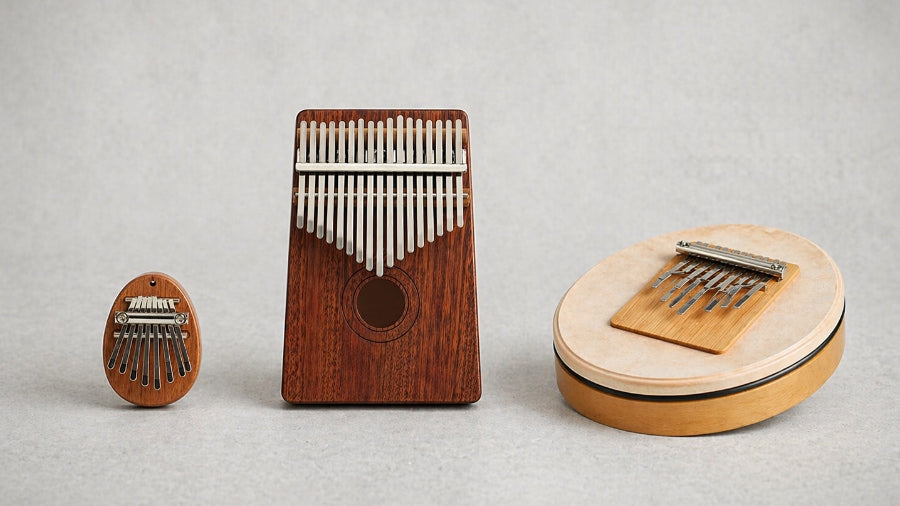
Not all kalimbas are equal, and kalimba price directly reflects the number of notes, build quality, sustain, volume, tuning stability, and long-term playability. In this kalimba price comparison guide, we break down entry-level 7–8 note models, full 17-note beginner instruments, and professional kalimbas to help you choose the best option for your budget and musical goals. Whether you’re looking for a starter kalimba, a serious learning instrument, or a lifetime professional model, here’s how they compare from £15 to £180.
£15 – Chisai Pocket Kalimba (8 Note)

£20 – Kuta Thumb Piano Kalimba (7 Note)

The 7 Note Coconut Thumb Piano Kalimba moves toward traditional craftsmanship with a hand-carved coconut shell body and natural resonance, offering 7 notes, a brighter higher pitch, short decay (50ms), and louder projection than the pocket model. Its strengths include an authentic handcrafted aesthetic, warmer organic look, good projection for its size, and tunability, while limitations remain in its restricted note range, short sustain, separate tuning hammer requirement, and suitability mainly for simple melodies. Best for beginner musicians who value cultural authenticity and natural materials, it remains entry-level musically but delivers stronger character and presence than the pocket version.
£25 – Yulin Kalimba (17 Note)

The 17 Note Yulin Kalimba is where you move into full-range musical territory, offering 17 notes in C major, a solid wood body, long sustain (1076ms), very loud projection and a full starter bundle including tuning hammer, stickers and soft case. Its strengths include wide melodic range, strong sustain, full volume and presence, tunability, included accessories, and suitability for advanced players, while limitations are slightly heavier weight and a steeper learning curve than 7–8 note models.
Best for anyone serious about learning, it delivers the strongest value-to-performance ratio in the lineup— for just £10 more than the Kuta, you gain more than double the sustain and significantly greater range, making it the smart beginner investment from a price-to-musical-capability perspective.
£180 – Hokema Kalimba (17 Note)

The 17 Note Hokema Kalimba is professional-grade, handcrafted in Germany from American black cherry wood, polished with vegetable oil and wax, and precision tuned for serious performance. For the price, you get 17 perfectly tuned notes, premium wood, refined sustain (737ms), controlled projection , superior tuning stability, and exceptional build quality, resulting in richer tonal warmth, balanced controlled resonance, precision tuning, suitability for sound therapy, and a long lifespan.
Limitations include the premium price and no starter accessories, and it’s best suited to serious musicians, sound therapists, and long-term players who understand what they’re buying—this is not a starter experiment, but a lifetime instrument.
What Does Price Actually Change?
As price increases, a kalimba typically offers more notes (greater musical range), better sustain, higher volume, improved tuning stability, higher-quality wood, cleaner tonal clarity, longer lifespan, and stronger craftsmanship. The biggest jump in musical capability is between 7–8 notes and 17 notes, while the biggest jump in craftsmanship is between Yulin and Hokema. Be honest about your intention: choose a Pocket Kalimba for fun and portability, Kuta for natural handmade character, Yulin 17 Note to properly learn, and Hokema for premium tone and long-term quality. If your goal is to truly learn songs and grow as a player, a 17-note kalimba is the baseline—anything below that limits you quickly. Price reflects capability, not just brand, so choose based on how serious you are about learning, not just your budget.


