Choosing a professional djembe drum isn’t about finding the most expensive instrument—it’s about sound quality, responsiveness, tuning stability, and how the drum translates your technique. Many players outgrow beginner djembes quickly, then feel unsure what actually separates a “professional” drum from an average one. This guide explains what truly matters when selecting a professional djembe, so you can make the right decision regardless of brand availability or trends.
What Makes a Djembe “Professional”?
A professional djembe is defined less by appearance and more by how it performs under skilled hands. These are the core factors that matter.
Shell Material and Carving Quality
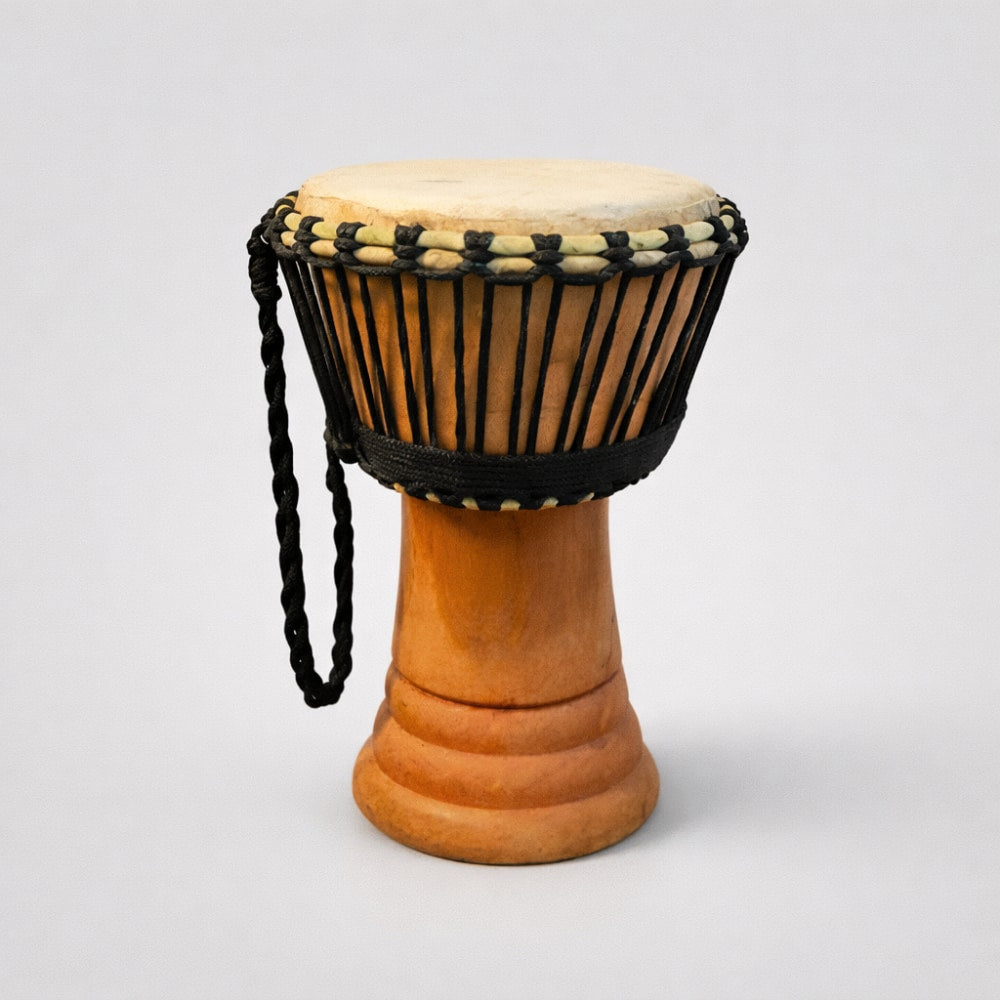
Shell material and carving quality determine how a djembe sounds and responds. Professional djembes use single-piece hardwood shells (such as mahogany, lenke, or cedar) with deep, even carving and balanced wall thickness—never glued sections or soft woods. Hardwoods deliver deeper bass and clearer slaps, while precise carving ensures consistent resonance and projection. If the shell is poorly carved, volume and tonal separation suffer. A true performance djembe should feel resonant and alive in the hands, not hollow or muted.
Head Type and Thickness
Head type and thickness define how clearly a djembe speaks. Professional djembes use natural goatskin—never synthetic—stretched evenly with no dead spots, usually in a medium-to-thick weight for balance. Skins that are too thin sound sharp but lack depth, while overly thick skins kill sensitivity. A well-chosen goatskin allows bass, tone, and slap to respond clearly across dynamics, giving the player control rather than just volume.
Rope System and Tuning Stability
A professional djembe must hold its tuning under regular playing. Look for high-quality rope (polyester or equivalent), clean and even verticals, and tight, well-set knots. Good rope work prevents slipping and stretching, keeps the drum stage-reliable, and allows proper tensioning—because even the best shell and skin will sound weak if the tuning system is unstable.
Size and Playing Context
Size matters only in context. Most professionals prefer 10–12 inch heads for balanced versatility, with larger djembes suited to outdoor or ensemble settings and smaller, more responsive drums ideal for studio work or teaching. The best djembe is the one that responds accurately to your technique, fits your body comfortably, and matches the environments you actually play in.
Technique Matters More Than the Drum
Technique matters more than the drum itself. Two players can use the same djembe and sound completely different because tone, clarity, and projection come from hand position, stroke accuracy, tuning knowledge, and consistent practice. Upgrading the drum alone rarely fixes this—the instrument only amplifies what you already do. Without solid technique and tuning awareness, even high-end djembes sound flat. Professional sound comes from understanding and control, not ownership.
Learn to Get a Professional Sound from Any Djembe

The Complete Djembe Drum Player was created to help players get a professional sound from any djembe by focusing on technique rather than gear. It teaches correct tuning, how bass, tone, and slap actually work, how to build consistent hand technique, and how to develop rhythm through structured practice—so sound quality improves regardless of drum price. With clear diagrams, tuning guides, practice sessions, and beginner-to-advanced lessons in a downloadable 50-page format, the book proves a simple truth: a good drum helps, but knowledge and technique are what make a djembe sound truly professional.
Download the Complete Djembe Drum Player Book