
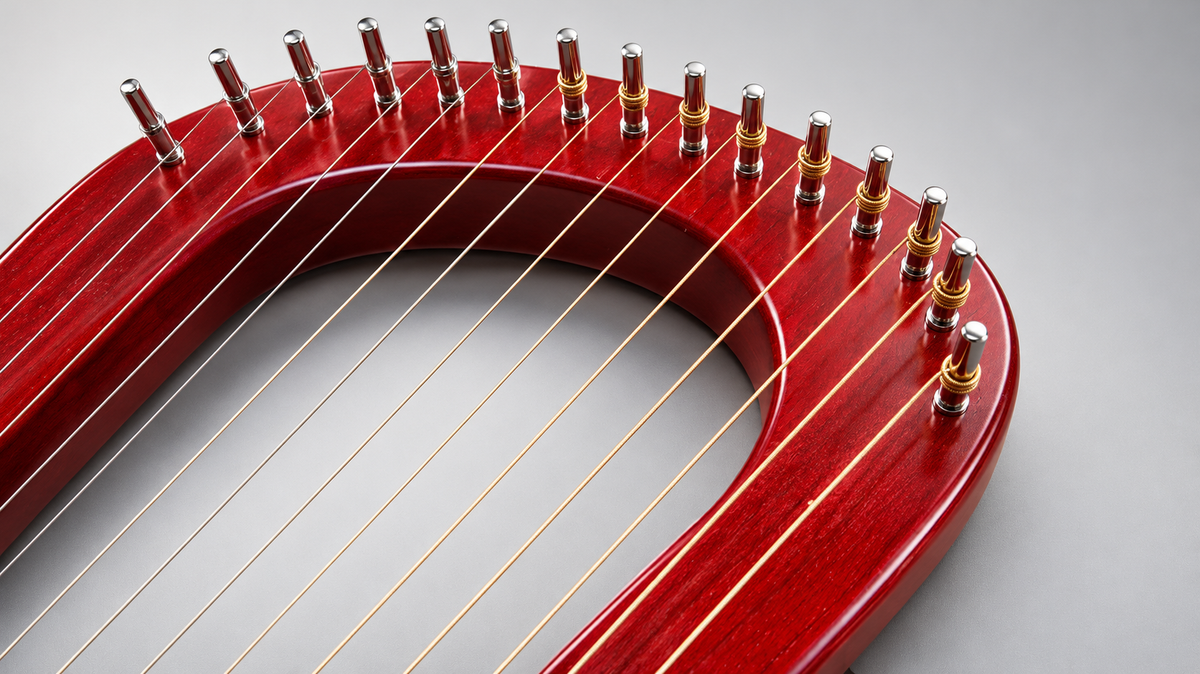
The lyre harp is a plucked string instrument with a gentle, resonant sound. You can begin by playing simple melodies with one hand, then explore chords and two-handed arrangements as your confidence grows. First, learn your instrument’s tuning and note layout.
How to Tune a Lyre Harp
Check your lyre’s note labels or tuning chart, as 15-, 16- and 21-string models can have different tunings. Using a chromatic tuner and the supplied tuning key, pluck each string and gently adjust its peg in small increments until it reaches the correct pitch. Repeat for every string, then check them again as the tension settles. Never force the pegs or overtighten the strings, and check tuning before playing, particularly after temperature changes.
How to Hold the Lyre Harp
For one-handed playing, support the lyre against your lap or body with one hand and pluck with the other. For two-handed playing, position it securely between your legs or against your body so both hands can move freely; a stable footrest may help prevent slipping. In either position, sit upright, relax your shoulders, keep your wrists comfortably straight and angle the instrument so you can see the strings without straining.
Basic Lyre Harp Playing Techniques
Start by gently plucking individual strings with the fleshy part of your fingertips to play simple melodies. For smoother phrases, try the harp-style technique: prepare several fingers on their strings, then curl them naturally towards your palm as you pluck. You can also glide a finger across a string towards the next, keeping your touch light and the lyre steady. Fingernails or a plectrum create a brighter, sharper tone, while fingertips produce a softer sound, so experiment to find the technique you prefer.
How to Play Chords and Strum

On a suitably tuned lyre, a basic major chord uses the first, third and fifth notes from its root: for example, C major is C–E–G. Pluck these notes together or individually, or strum them with your thumb or a pick while gently muting unwanted neighbouring strings. Your thumb usually produces a softer tone, while a pick gives a brighter sound. Check that the notes are available on your lyre before playing.
How to Play with Both Hands and Practise Effectively
Learn the melody slowly with your dominant hand, repeating difficult notes and transitions rather than restarting the whole song. Once comfortable, add simple bass notes, chord tones or broken chords (arpeggios) with your other hand. Practise each hand separately before combining short phrases, keeping the lyre securely supported. Start with a comfortable metronome tempo, such as 50 BPM, and increase by 5–10 BPM as your playing becomes steady. Take breaks when you feel tense or lose concentration; short, focused sessions help build confidence and coordination.
Your First Song: Ode to Joy
Ode to Joy is a useful first melody because its phrases repeat and it uses neighbouring notes. For a lyre with the appropriate notes, try the opening phrase:
E E F G | G F E D | C C D E | E D D
Play each note evenly, first with one finger and then using prepared finger placement. Repeat the phrase until it feels natural before moving on. If your lyre is tuned differently, use a suitable transposition or arrangement for its available notes.
Choosing and Caring for Your Lyre Harp

The Gecko Cherry Lyre Harp is a 15-string instrument crafted from solid mahogany, with a rich cherry-red finish and a warm, resonant tone. Its compact, portable design is ideal for learning melodies and exploring simple arrangements. Complete with a carrying case, tuning key and spare strings, it has everything you need to begin. Preserve its beautiful sound by storing it in its case in a cool, dry place and gently wiping it clean after playing.